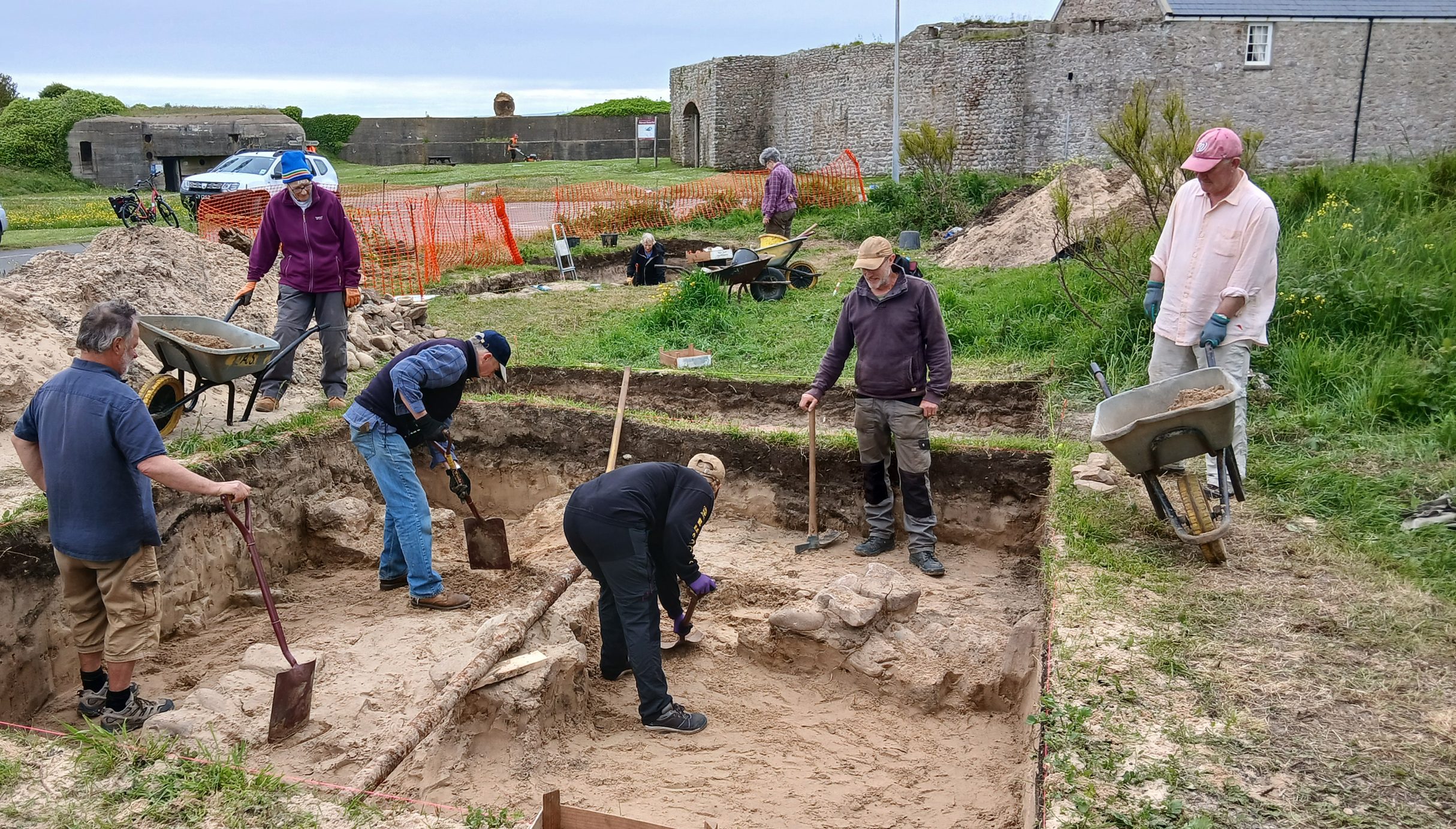
Our team of friends and colleagues have been digging on Alderney every year since 2007, with an understandable break in 2020. Our initial focus was on the Roman fort at the Nunnery, but chance discoveries in an electric trench in 2017 led to our attention shifting to nearby Longis common.
Dig Alderney divided its efforts in 2026 to make best use of resources and to advance two projects at once. Dr Jason Monaghan took the smaller team of three to four diggers and carried out a test-trenching exercise in the Paddock. We’ve been teasing out evidence for a Roman settlement there since 2017 but are not sure exactly what it was, or how extensive it was.
We attacked the problem methodically, planning small ‘test trenches’ at specific points where a ground penetrating radar survey had indicated there might be structures under the ground – ‘geophys’ for Time Team fans.
The common sits on sand several metres deep, interrupted by layers of human activity going back in time. Part way down in the first two trenches we came to a nicely preserved medieval ploughsoil, complete with marks left by the plough.

Below that was ‘dark earth’ replete with Roman pottery. Dark earth is often found spread over a Roman site, a final layer of rubbish and decay after the buildings were abandoned. Unfortunately we also found water, little over a metre down; finding exactly how deep the water table is will help guide future work.

The third trench was slightly higher up the slope, it still had the ploughsoil and the dark earth but below that was the line of a Roman wall. Water flowed in to spoil our delving deeper but we now know the depth and direction of the wall if we come back in a dry summer. All three trenches added points on the map we’re building up of this settlement.
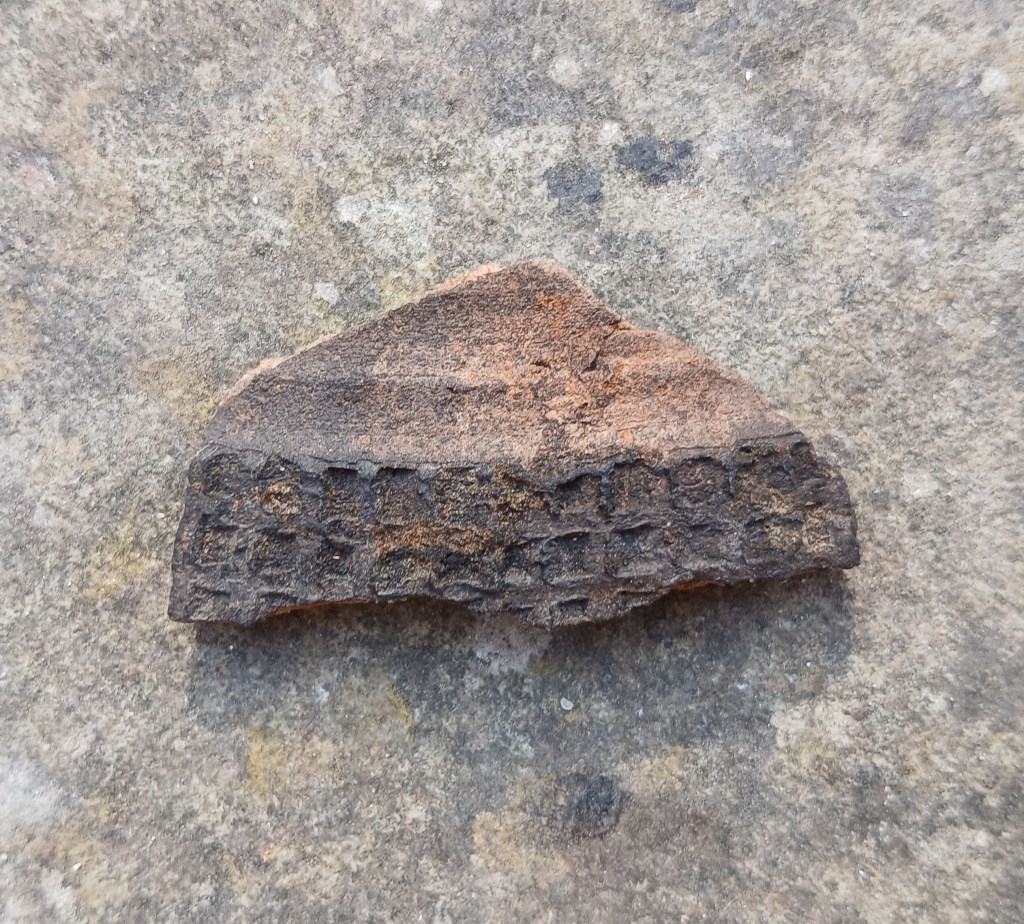
We were very excited to retrieve a sherd of Merovingian Frankish pottery from the dark earth. This is incredibly rare in the Channel Islands and shows our ‘Roman’ site continued to be inhabited into the sixth century. It would have been the highlight of the dig, but….
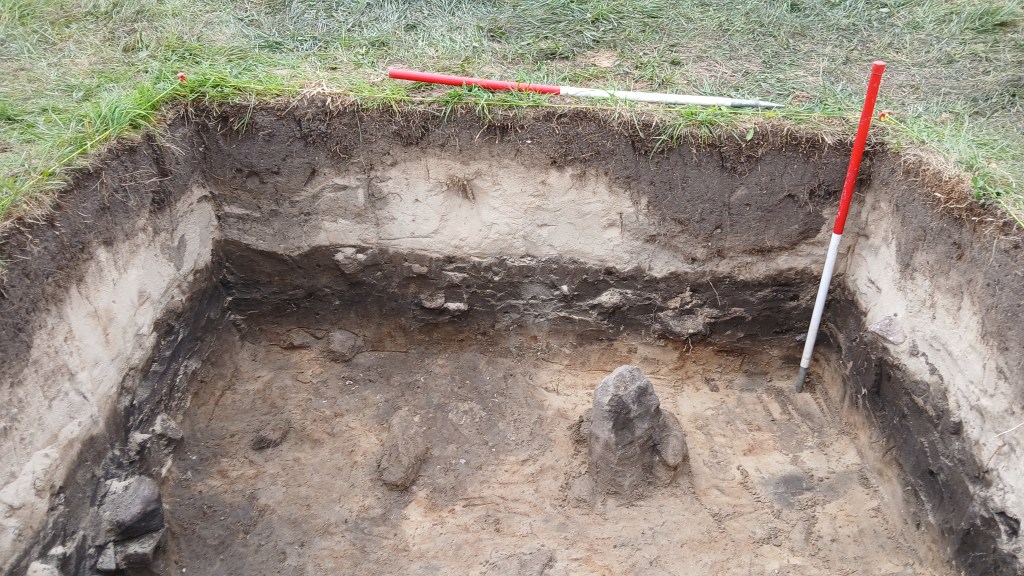
Trench six (we skipped two) was much further upslope, again chosen on the basis of ‘geophys’ but with hope we wouldn’t hit water so early. No ploughsoil this time, but the dark earth seemed humped over some Roman structure now destroyed. Scattered stones were removed one by one but gave no clue as to what had once been there.
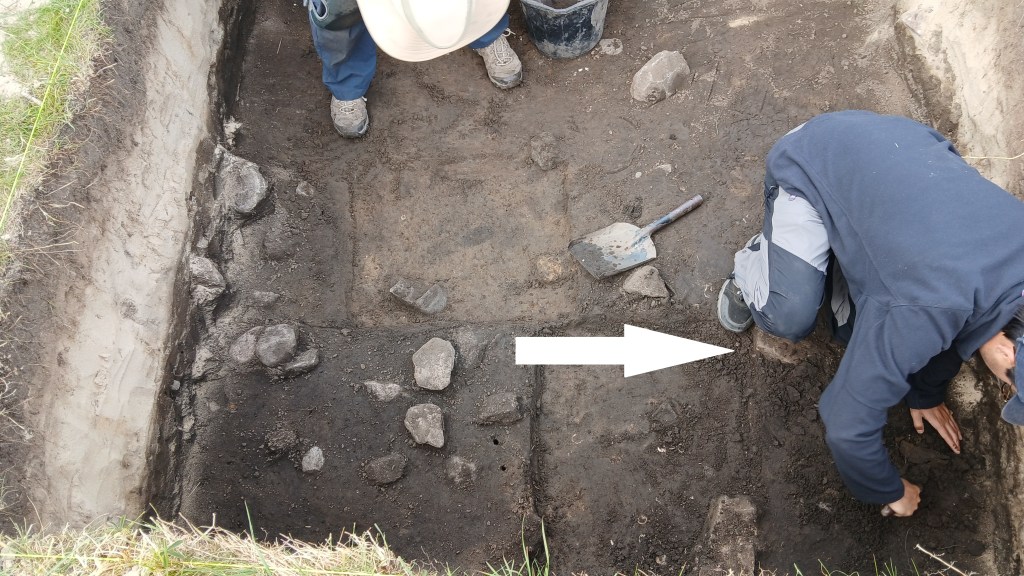
One stone stuck stubbornly through the dark earth (follow the white arrow). We cleared soil away from around it as the trench grew deeper… down and down went the stone.
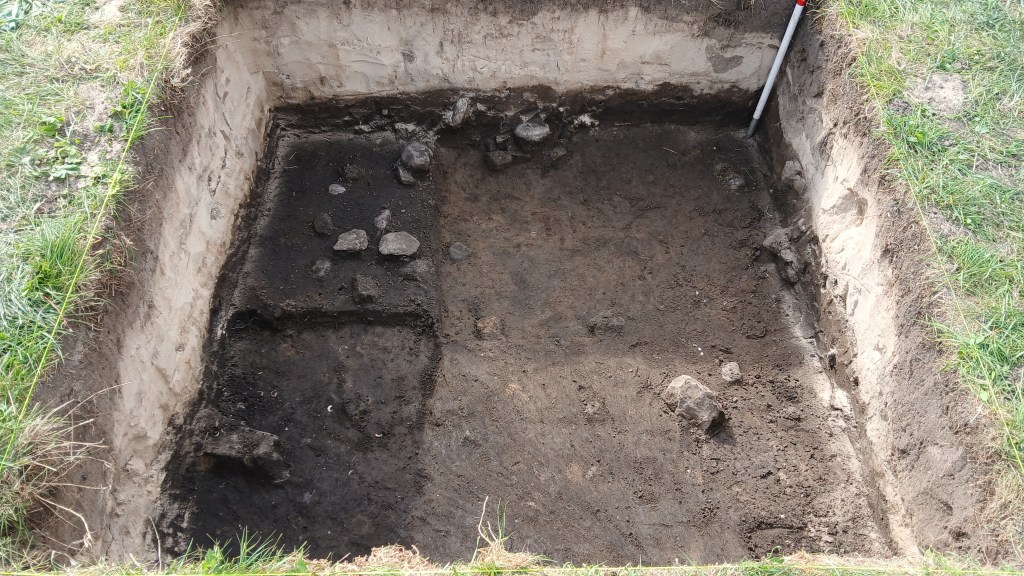
The dark earth was gone, coming onto what looked like a floor of hard-trampled sand and debris. By now we started referring jokingly to the ‘menhir’ sticking 20 centimetres proud of the Roman surface.
Wait…is that a face?
Perhaps it is in the eye of the beholder, but our stone appears to have a face. It’s looking downhill, to the south-east, to the sea. The lower parts of the stone have been squared off, the edges have been trimmed but the front and back looked natural. Joking subsided – was this actually a menhir, a standing stone? Without getting too carried away it could have been no more than a boundary marker if not something as unromantic as a gatepost.

After the hard sand was gone, we were into soft wind-blown sand with Roman pot finds fading away, then just one piece of Iron Age pot, then finally we hit water. We established the stone stood to at least 1.2 metres, but had not reached the base, which was clearly somewhere down in prehistoric levels. Its back was left unexcavated so we – or future archaeologists – can return in a dryer month.
Had there been a face before the centuries took their toll? Had the stone been selected because its natural shape vaguely resembled a face? A left eyebrow, a nose and a suspiciously straight mouth can be discerned, with damage where the right eye should have been. Lower down is perhaps the suggestion of a belly. The very top of the stone may have been pecked to give a dished appearance, perhaps stylised hair or a crown. If this is a statue-menhir it’s an incredibly rare discovery for modern times. Alderney keeps on surprising us.
We were very excited, yet tempered this with cold scientific logic. The face may in fact be a trick of the eye, the product of tired imaginations on the final day of the final test trench. It deserves further investigation with a larger trench in a dryer season, knowing now what we’re looking for. The top of the stone is approaching a metre below ground level and on private land so there was no more we could do but precisely record its position, protect it, then bury it in sand once more. The mystery is back below the ground, waiting.
Note; this post is based on Jason Monaghan’s personal blog on www.monaghanfoss.com. A formal archaeological report on the discovery will be published in the Alderney Society Bulletin. All images are copyright Dig Alderney.